
Guide
Jetty substructure: piles or floats?
For most waters, floats are the simpler substructure: a floating jetty follows the water level, needs no load-bearing bottom and no piling work, and two people can build it themselves. Piles mainly pay off in very shallow water with a constant level. Often the combination works best: a floating jetty guided on piles.
What is the difference between a piled jetty and a floating jetty?
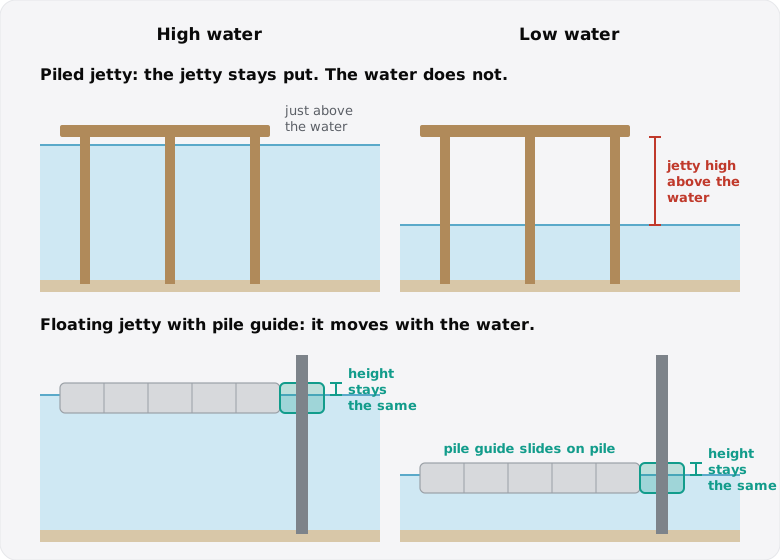
A piled jetty stands. Timber or steel piles are driven, jetted or screwed into the bottom, with beams and decking on top. Its height is fixed, however high the water happens to be.
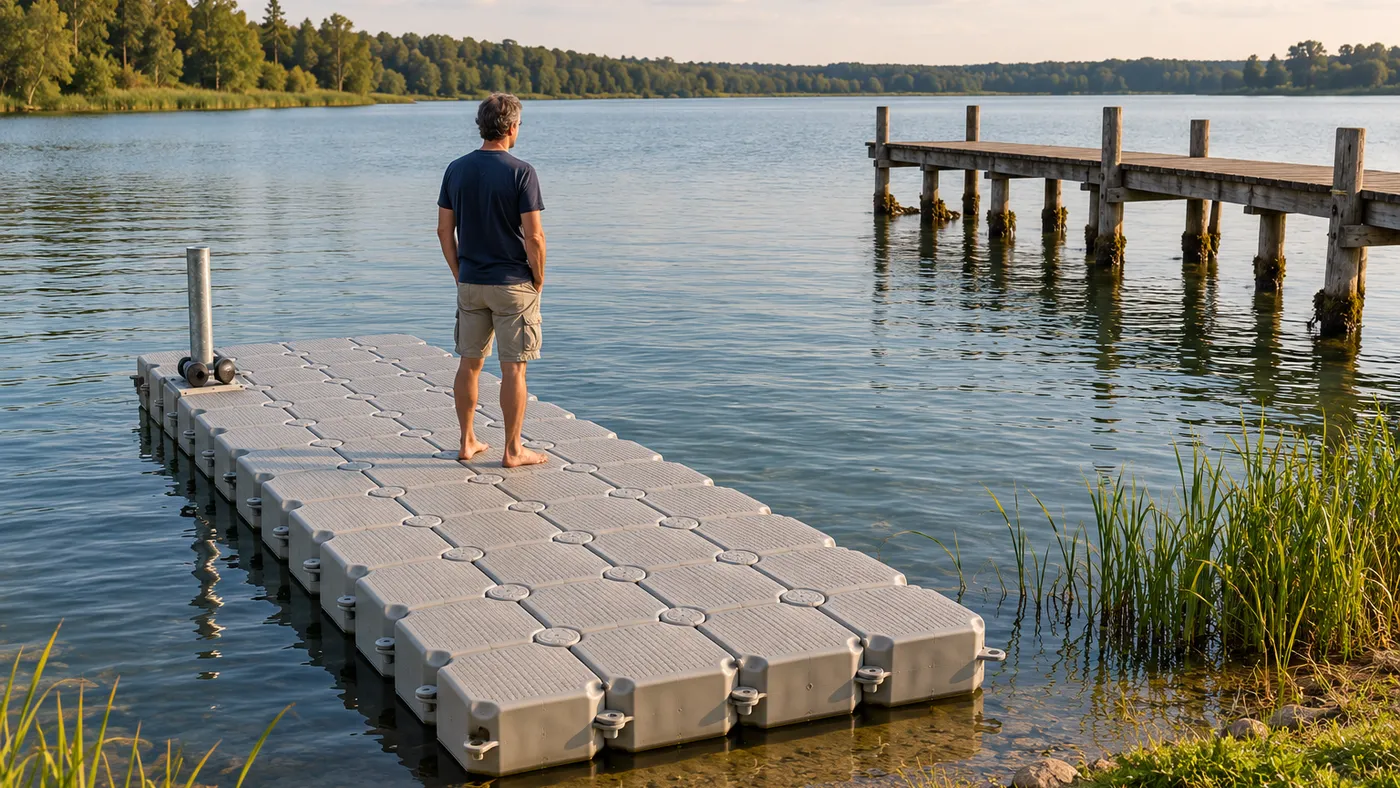
A floating jetty floats. The floats themselves are the substructure: they carry the jetty and form the walking surface at the same time. When the water rises or falls, the jetty goes with it. To keep it from drifting away, brackets hold it on the bank and piles or anchors hold it in the water.
When is a floating jetty the better substructure?
Whenever one of the following applies. On most lakes, rivers and canals, at least one does:
- The water level varies. At high water a piled jetty sits just above or below the surface, at low water high above it. A floating jetty always sits at the same height above the water, and a boat can come alongside comfortably at any level.
- The water is deeper than a metre or two. The deeper the water, the longer and thicker the piles have to be, and the more work the piling. Depth makes no difference to a floating jetty; from 80 cm it floats freely.
- The bottom is soft or rocky. Short piles find no hold in mud and can hardly be driven into rock. A floating jetty needs no load-bearing bottom; on soft ground a ground anchor holds it.
- You want to build it yourself. Piles are usually set by a specialist firm with piling equipment, often working from a boat or pontoon. Two people can put a floating jetty together without a crane, first on the bank, then in the water.
- The jetty should be able to grow or move. You can add or remove floats at any time, or rebuild the whole jetty somewhere else.
Piled or floating jetty: the comparison
| Criterion | Piled jetty | Floating jetty |
|---|---|---|
| Varying water level | sometimes just above, sometimes high above the water | follows the level, height above the water stays the same |
| Minimum depth | even very shallow water | 80 cm (H40), 50 cm (H25) |
| Bottom | must support the piles | any; ground anchor on a soft bottom |
| Assembly | piling equipment, usually a specialist firm | two people, no crane |
| Upkeep | paint the timber, check corrosion protection | none |
| Extending, moving | laborious | any time |
| Movement | none | slight, steady from 1.5 m wide |
| Permit | ask the authority | ask the authority |
Minimum depth as recommended by Ponton+: twice the height of the float.
When are piles the better choice?
A fixed piled jetty has its place where the water is very shallow and the level hardly changes. For our standard 40 cm floats we recommend at least 80 cm of water, for the low 25 cm floats at least 50 cm. If the water is shallower than that along the whole length of the jetty, a piled jetty is the safer option.
If only the shore end of a floating jetty has to cross shallow water, that is no reason for piles. If the floats rest on the bottom there, it does them no harm, as our own pontoons in use show. What matters is that the outer part floats freely.
And some people simply want a jetty that does not move at all. A floating jetty made of floats lies steady in the water from 1.5 m wide, but there will always be a little movement in waves. If you do not want that, build on piles.
Can you combine piles and floats?
Yes, and it is often the best solution. The jetty floats on floats, and one or more driven piles keep it in place. On the jetty you fit a pile guide: a plate in the float grid (50 × 50 cm) with three rubber rollers that the pile runs between. The jetty slides up and down with the water level but can neither drift away nor turn.
We recommend this solution for up to three metres of water with a firm bottom. The pile guides come in four internal diameters from 100 to 260 mm. The pile should have 10 to 20 mm of play so the guide does not jam with ice or fouling. We do not supply the piles themselves; you can get them from a local marine contractor or steel stockist.
In deeper water or on a soft bottom, a 40 kg ground anchor with anchor bracket and chain replaces the pile. The manufacturer recommends four piles or two ground anchors per jetty, plus at least two brackets on the bank. With strong current or high waves, we work out the anchoring in the quote. More in our guide Anchoring a floating jetty.
- Pile guide S, internal Ø 100 mm: €175
- Pile guide M, internal Ø 160 mm: €225
- Pile guide L, internal Ø 220 mm: €255
- Pile guide XL, internal Ø 260 mm: €295
- 40 kg ground anchor: €265, plus anchor bracket €76.50
- L-shaped jetty bracket for the bank: €135
All prices net. You will find all anchoring accessories under Accessories.
How much does a floating jetty carry in comparison?
Our floats carry 350 kg per square metre; that is the manufacturer's figure. A single 50 × 50 cm float therefore carries around 87 kg. A 1.5 × 6 m jetty carries around 3.1 t, far more than ever gathers on a private jetty. At full load a 40 cm float sinks in by around 35 cm; in everyday use with a few people, the jetty sits much higher.
With a piled jetty, the load capacity depends on pile spacing, beams and decking. The jetty builder determines that case by case; there is no general figure.
What does the substructure cost?
With a floating jetty, the substructure is the jetty. A 1.5 × 6 m jetty of 36 floats costs €2,239.50 net in materials, including all pins, bolts and rings. No boards, beams or concrete are added. For anchoring, allow one pile guide from €175 per pile plus the pile itself, or €265 per anchor plus anchor bracket and chain. The full parts list is in our guide Building a floating pontoon.
We do not quote prices for piled jetties, because we do not build them. If you compare, make sure the quote covers piles, piling work, beams and decking together. A fair comparison is only possible on the finished, walkable surface.
How long do piles and floats last?
Timber piles and decking work in the water; they have to be inspected, painted and eventually replaced. With steel piles it is the corrosion protection.
Our floats are made of HDPE, a plastic that absorbs no water, does not rot and never needs painting. It is frost-resistant, so the jetty can stay in the water over winter. We give a five-year warranty on the float material.
Is a floating jetty more likely to need a permit than a piled one?
Not as such. Whether a permit is needed depends on the country and the body of water, and that applies to a piled jetty and a floating jetty alike. The responsible authority will tell you what applies at your site.
In practice the floating jetty has one advantage: it can be removed without leaving anything behind, with no piles left in the bottom. Best ask the responsible authority before you buy. This is not legal advice. For the UK, the rules are set out in our guide Do I need permission for a pontoon in the UK?
Prices as per our price list of 01/10/2026. Prices may change. Before you buy, get a current, binding quote via the configurator or an enquiry.
Plan your jetty
Enter length and width in the configurator and tell us in your enquiry how deep the water is, how much the level varies and what the bottom is like. We will then recommend the right anchoring, with pile guide or ground anchor, and put everything together in one quote.