
Guide
Can a floating pontoon stay in the water over winter?
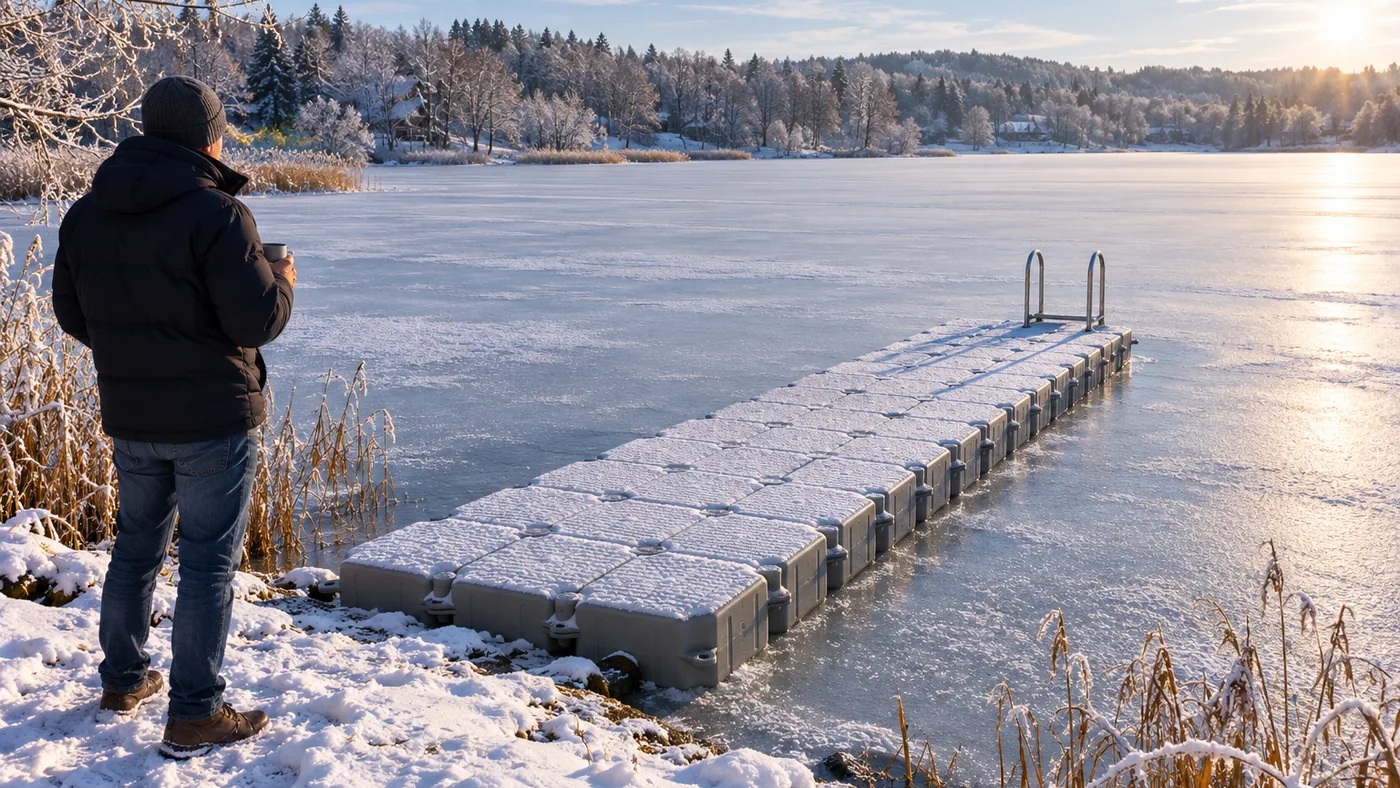
Yes, a floating pontoon made of HDPE floats can stay in the water all winter on most waters. Frost and ice do not damage the material, because HDPE absorbs no water. Only moving ice is a risk: if drifting ice or wind pushes ice floes against the jetty, you are better off bringing it ashore.
Does frost damage the floats?
No. Our floats are made of HDPE, a plastic that absorbs no water. So no water can freeze inside the material and burst it, as happens with timber or concrete. According to the manufacturer, the material can be used from −60 °C to +80 °C and is frost-proof and UV-resistant. Every float has pressure equalisation, and water does not normally get in. It needs no care and no painting before winter.
The same goes for the stainless steel accessories. Our own swim ladder has been hanging in the water on our pontoon all year round for four years, without any problems.
When should the jetty come ashore for winter?
When the ice moves. If the ice lies still, the jetty simply freezes in and thaws out again in spring. But if current, wind or rising water push ice floes against the jetty, large forces act on the anchoring and on the coupling pins between the floats. The material can take that; the connections and anchors may not.
That is why there is no fixed ice thickness at which the jetty has to come out. Ask yourself one question: does the ice simply melt back into water where it is in spring? Then the jetty can stay in all year. If, on the other hand, large blocks of ice drift with the current, bring it ashore beforehand, because that kind of ice breaks up any fixed structure.
So it is your water that decides, not the temperature. The table shows our recommendation for typical cases.
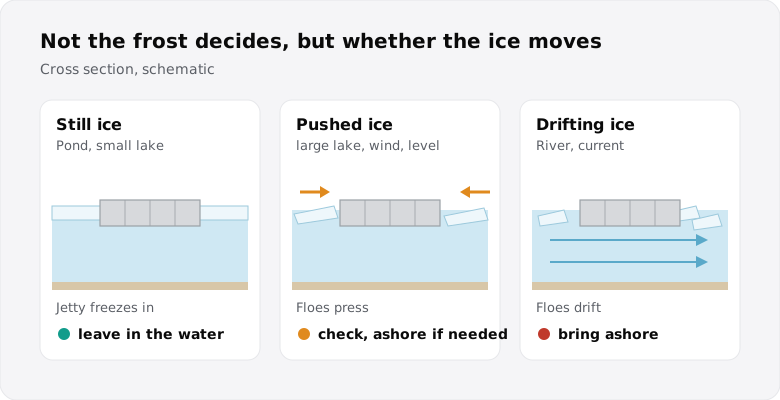
Floating pontoon in winter: recommendation by type of water
| Water | Ice in winter | Our recommendation |
|---|---|---|
| Garden pond, small bathing lake, gravel pit lake | lies still, jetty freezes in | leave in the water |
| Large lake with open shore | wind can push ice floes | check anchoring, bring ashore if ice is pushing |
| Water with a strongly varying level | ice lifts and lowers the jetty | pile guide with play, or bring ashore |
| River or canal with current | drifting ice, moving floes | bring ashore |
Guide values. If in doubt, describe your water to us and we will tell you what we recommend.
How do I prepare the jetty if it stays in the water?
With a few simple jobs in autumn:
- Check the connections: Walk the whole jetty once and check that all coupling pins are firmly locked and all bolt sets are tight. Retighten loose pins with the pin spanner.
- Check the anchoring: Inspect chains, anchor brackets and shore brackets. With piles, the pile guide needs 10 to 20 mm of play so it does not jam in ice and the jetty can rise and fall with the water level.
- Remove loose accessories: Bring fenders, lines and anything you will not need over winter ashore. Firmly bolted parts such as the swim ladder, cleats and cross bollards can stay.
- Check during winter: Have a quick look at the jetty after storms, during a thaw and when the ice breaks up. Snow counts fully against the load capacity of 350 kg/m². So it is best to clear heavy snow, especially wet snow.
How do I bring the jetty ashore?
You take it apart into sections, pull them to the bank and store them there. No crane is needed, because the connections are pinned and bolted, not glued or welded:
- 1. Remove accessories: Take off the swim ladder, railing and loose accessories.
- 2. Release the anchoring: Release chains or pile guides and secure the jetty with a line so it does not drift away.
- 3. Split into sections: The coupling pins are locked with a quarter turn. Turn them back with the pin spanner and pull them out. Split the jetty into sections that two of you can move easily; a single float weighs just 6.8 kg.
- 4. Pull ashore: Float the sections to the bank and pull them out there.
- 5. Store: Lay them above the high-water line and secure them against wind, because the sections are light. You can stack floats and sections up to 10 layers high, as long as the stack is at least 2 floats wide. Collect pins and bolt sets in a box so nothing is missing in spring.
In spring you put the jetty back in reverse order. Because the system is modular, you can extend or rebuild it at the same time. How assembly works in detail is explained in our guide Building a floating pontoon.
Does the warranty cover ice damage?
No. The five-year warranty covers the material when used as intended. It does not cover damage from moving ice, for example pins that break when ice floes push against the jetty. Get in touch anyway if something has happened: we look at every case individually and check with the manufacturer whether a goodwill solution is possible.
The best approach is to avoid the damage: if your jetty is on water with moving ice, bring it ashore in good time.
Does a jetty in a garden pond stay in over winter?
Yes. On a garden pond the ice lies still, with neither current nor drifting ice. The jetty can stay in the pond all year round. More on this in our guide Pond jetty.
What about swim platforms and club jetties?
The same applies. A swim platform on a bathing lake can stay in the water; only in heavy drifting ice do you bring it ashore in sections. For large installations belonging to clubs and local councils, it pays to plan at the time of purchase how you will split them in autumn: we are happy to agree with you in the quote where the sections will be separated.
Questions about your water?
Tell us where your jetty is, how big it is and what your water looks like in winter. We will tell you whether it can stay in and how best to split it. For a new jetty, the configurator shows you the parts list and material price straight away.